How do I get more clients for my business?
Most service businesses don't have a marketing problem — they have a pipeline problem: inquiries that arrive, go unanswered, or never become booked work. These are the questions owners actually ask, answered the way we answer them in a fit review.
Why are good leads not becoming booked jobs?
Usually one of four things, and each has a different fix: (1) the response is too slow — a qualified inquiry answered in two days is already with the competitor who answered in twenty minutes; (2) the follow-up stops after the first "no" or the first silence — most bookings close on the second or third touch; (3) the quote is right but the path is broken — the customer can't easily see your work, trust you, or book the next step; (4) the lead isn't qualified — you're getting volume from the wrong kind of customer. A fit review is where we find out which one is yours, because the fix for each is completely different.
How many new jobs do I actually need to add $30,000?
Do the math backwards. A $30,000 goal at a $1,500 average job value is 20 jobs. If your booking rate is 25% — one in four qualified inquiries becomes booked work — you need 80 qualified inquiries for the period. If you currently get 30 a month, that's the gap: 50 more qualified inquiries, or a better booking rate, or both. The Booked-Job Readiness Score does this calculation for you in about a minute, with your own numbers.
What should a service business spend to win one new client?
Less than one client is worth. That's the only rule that matters. A $5,000 job or a client who returns monthly justifies an investment of a few hundred dollars to win them — many times over. A $150 job does not, no matter what anyone sells you. Which side of that line you're on decides whether you need a growth engagement, a paid-campaign budget, or something else entirely — and the fit review is where we put your numbers on the line and see which side it lands on.
How fast should I respond to a new inquiry?
Same day, ideally within the hour. The owner who responds first with a straight answer usually wins the booking — not the cheapest, not the best-reviewed, the one who answered. In urgent trades (restoration, emergency repair, last-minute moves) the window is minutes. If your team can't respond fast today, that's the single highest-leverage fix available, and it costs nothing but a process: someone owns the inbox, templates make the first answer good, and nothing waits overnight.
Am I ready for more work — or will new leads be wasted?
Be honest about three numbers before you grow: How many extra jobs or clients could you actually fulfill next month? Can you quote, schedule, and deliver at your current quality if volume doubles? Does someone follow up until it's booked or explicitly lost? If the first answer is "zero," the project isn't demand — it's capacity, and we'll say so. If the answers are real, then more qualified inquiries will almost certainly become booked work, and that's what the engagement is built to produce.
Why do prospects ask for a quote and then disappear?
Usually they're comparing you with two or three others — and the comparison is decided by whoever makes the next step easiest. A quote that arrives slowly, with no clear next step, no way to see recent work, and no simple way to say yes loses to the competitor who answered in an hour with photos, a clear process, and a one-tap way to book the walkthrough. Disappearance is rarely about price; it's about momentum. Keep the momentum by making the next step immediate after every quote, and following up before the silence becomes an answer.
What makes a homeowner choose one company over another?
In the shortlist moment — when three names are up on the phone screen — the decision is about safety, not price: recent work people can see, recent reviews from real neighbors, a profile that looks current and complete, and a business that answers when they call. Every one of those is a business state, not a marketing trick — and every one of them can be fixed deliberately. When a customer can trust the name before the quote is even read, the quote has a real chance to close.
A real example
What a trustworthy presence looks like.
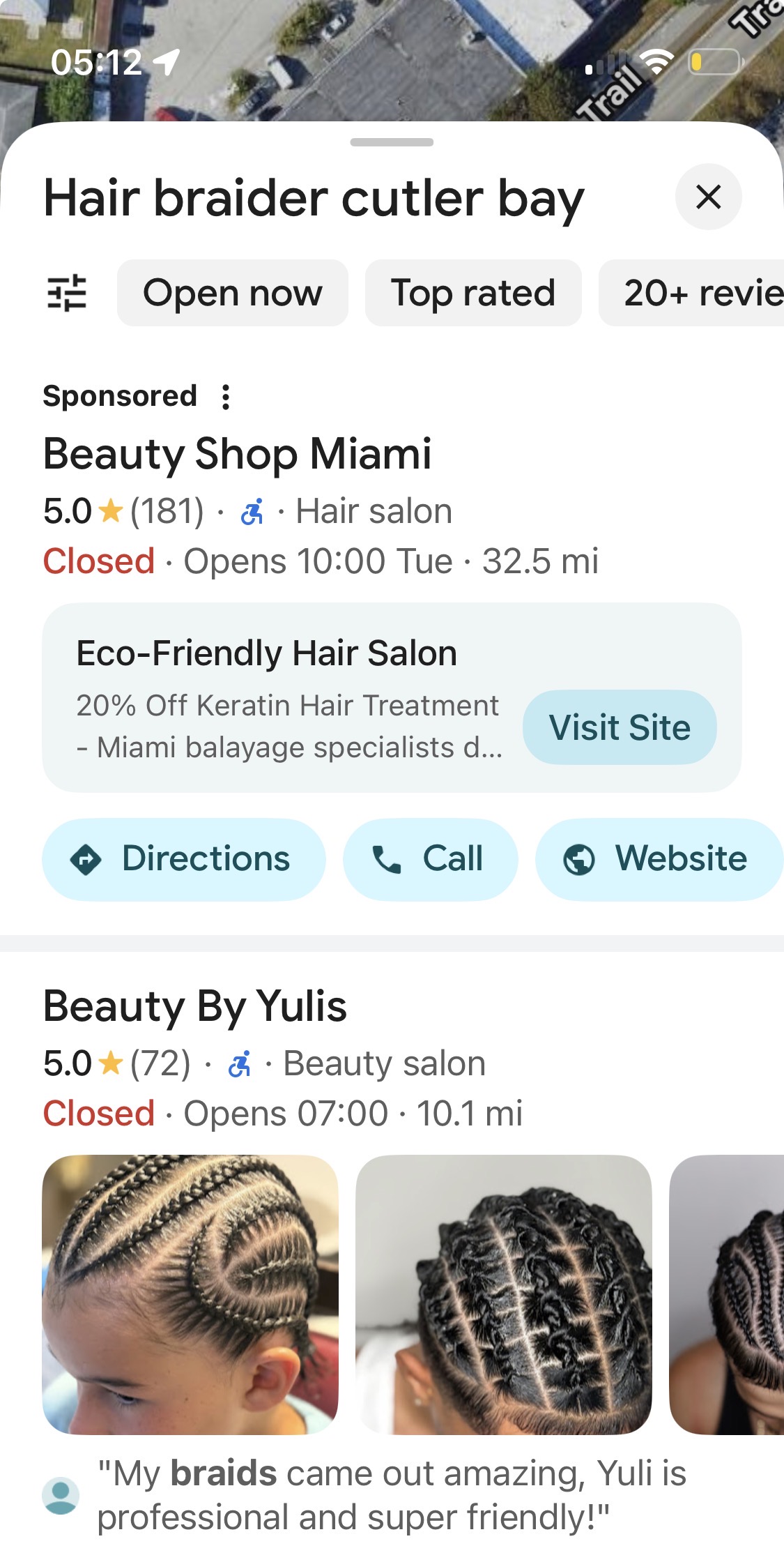
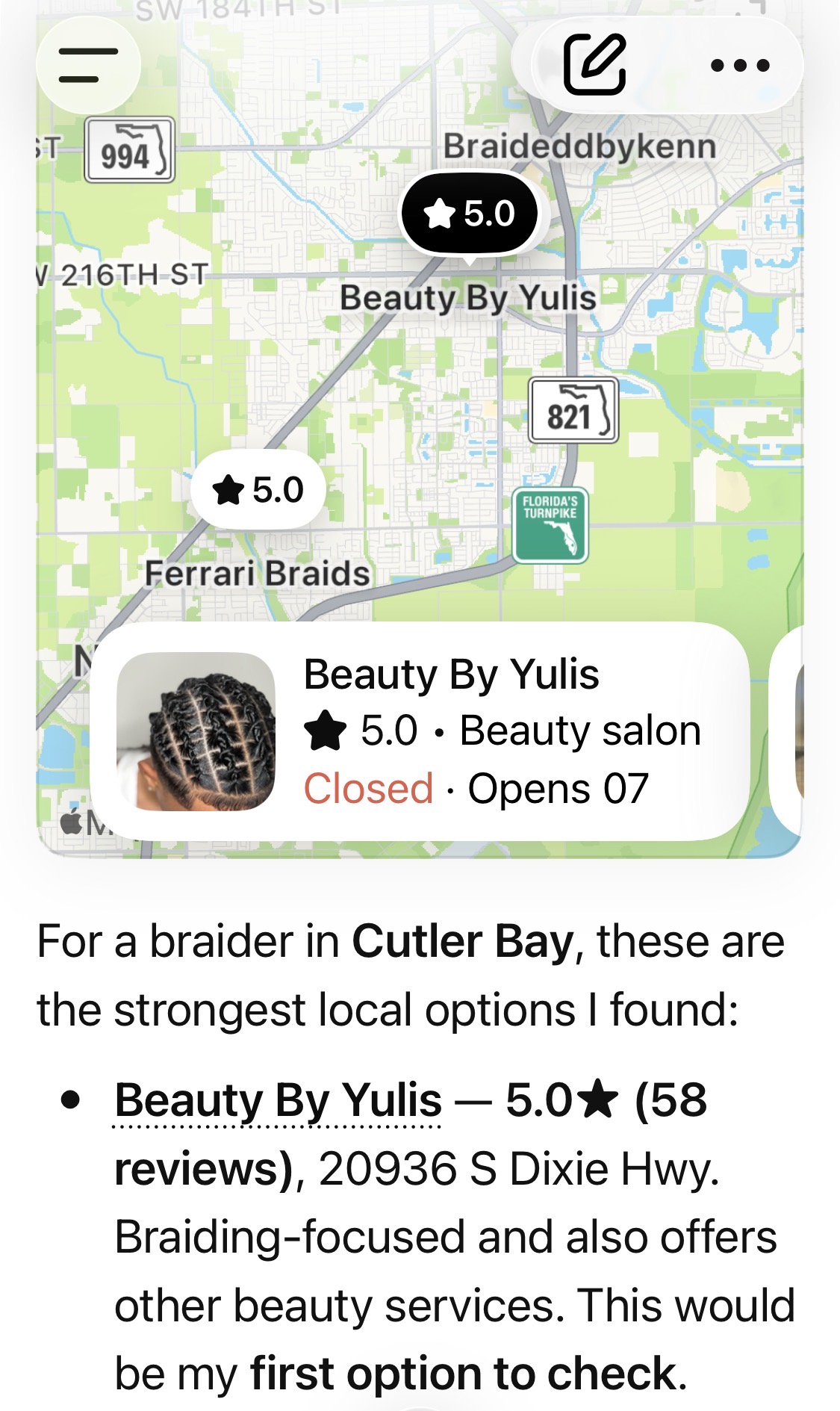
These screenshots, provided on August 31, 2026, show Beauty By Yulis appearing in local results for "hair braider Cutler Bay" and being named as a local option in an AI-generated recommendation for a braider in Cutler Bay. That's the shortlist moment in action: the business shows up complete, current, and trusted — and the booking request follows on a text. These are examples of where a real customer looked before they chose, not a promise of a particular result for anyone else's business.
So what's the actual answer to "how do I get more clients?"
Four parts, in order: (1) be where ready customers look, complete and current, so you make the shortlist; (2) make the next step immediate — a call, a text, a booking — so the inquiry doesn't cool; (3) follow up until every opportunity is booked or explicitly closed, so nothing leaks; (4) measure the whole path — inquiries, booked work, collected revenue — so the next month improves the last. The founding engagement operates all four, on one profitable offer, for 90 days, with the record in writing. Or if you're earlier in the thinking, the Readiness Score will tell you where your own bottleneck is.
Want a practical answer for your specific business?
Apply for a founding-client spot — the fit review is where we run these questions against your actual numbers and give you a straight answer, whether or not it's a fit.
Apply for a founding-client spot